
Psychological Flexibility and Workplace Resilience in a World That Won’t Slow Down
- Michael Griffiths

- 2 days ago
- 3 min read
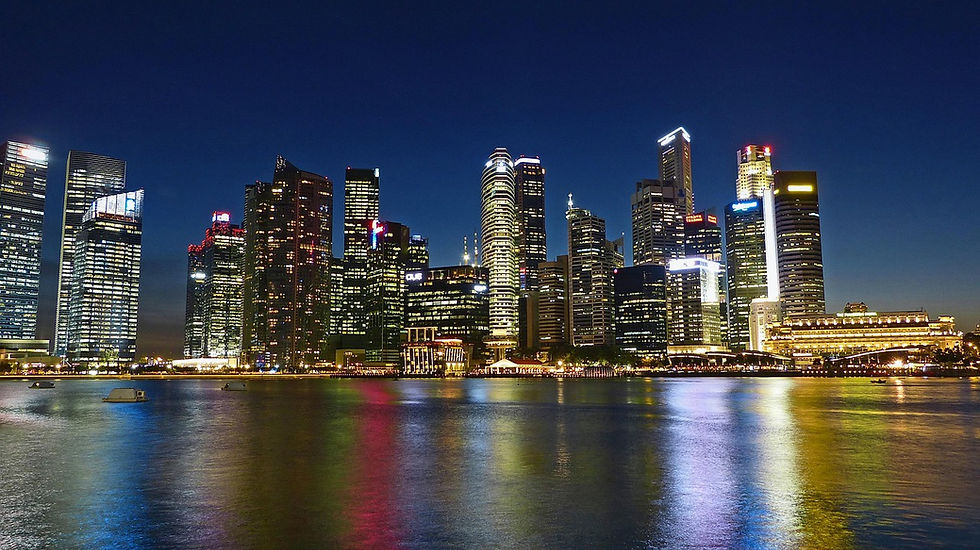
One of my favourite albums was 40 years old in 2025: Rain Dogs by Tom Waits. This musical masterpiece opens with a song called Singapore and Waits with his wonderful descriptive ability, conjures up images of a bustling, lively and sometimes menacing port full of characters who might sing to you and rob you in a single encounter.
As I was listening to this song recently, I thought about ports like Singapore and my hometown of Glasgow in its heyday as places defined not by permanence, but by movement. Ships arrive and depart. Goods change hands. Risk is ever present, but so is opportunity. Nothing stays still for long.
Such places are demanding, dynamic environments. They reward adaptability, situational awareness and judgement under pressure. In that sense, they offer a useful metaphor for modern business — particularly in global commercial hubs such as Singapore and New York. These cities operate at the centre of global trade, finance and innovation, and by their nature they absorb more risk and uncertainty than regions of lesser prominence.
You could say that uncertainty in these environments is not an occasional disruption. It is structural.
Talking about New York and keeping with the music metaphor, a few years before Waits’ Rain Dogs, New York’s music scene was evolving under intense economic and cultural pressure. Some of my favourite bands such as Talking Heads, Television, and artists like Iggy Pop were working in conditions of volatility, limited resources and constant scrutiny. Rather than retreating into rigid identities, they adapted. They blended influences, experimented with form and stayed committed to direction even as circumstances shifted.
What they demonstrated was not control, but psychological flexibility.
So why is psychological flexibility in a world that wont slow down so important?
In organisational terms, psychological flexibility refers to the ability to remain present, open and effective in the face of challenge — a concept rooted in Acceptance and Commitment Therapy (ACT). ACT was developed precisely for contexts where uncertainty cannot be eliminated and performance still matters. It focuses on helping people notice internal experiences — thoughts, emotions, impulses — without being driven by them, while staying aligned with what matters most.
In the workplace, psychological flexibility is a core ingredient of resilience. Not resilience as endurance or toughness, but workplace resilience as the capacity to adapt, recover and continue to perform well under sustained pressure.
This is increasingly relevant for organisations operating in complex, fast-moving environments. Strategy and systems matter, but they are rarely the limiting factor when conditions become uncertain. More often, it is human behaviour under pressure that determines whether organisations respond deliberately or reactively.
The Flex Advantage, as articulated by Bonmotus, describes how psychological flexibility shows up in practical business terms: leaders who can stay present in difficult conversations; teams that resist urgency-driven decision-making; organisations that continue to act in line with their values even when outcomes are unclear.
Global business hubs place sustained psychological demands on decision-makers. Without flexibility, organisations tighten, over-control or chase short-term certainty. With it, they maintain clarity, alignment and follow-through — the foundations of sustainable performance.
The artists who emerged from New York’s challenging cultural landscape did not succeed by eliminating uncertainty. They learned how to work effectively within it. Modern organisations face the same challenge.
In an economy that increasingly resembles a port rather than a fortress, psychological flexibility and workplace resilience is not a wellbeing add-on. It is a performance capability — and a strategic advantage.


Comments